
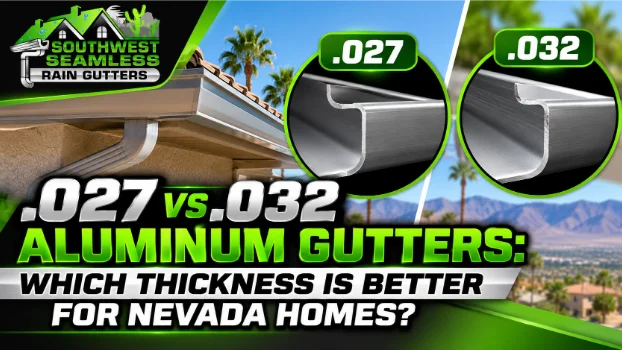
Choosing between .027 and .032 aluminum gutters comes down to durability, budget, installation quality, and the demands placed on the system. Both thicknesses are used for residential seamless gutters, but .032 aluminum provides more material and greater resistance to denting and deformation.
Quick answer: .032 aluminum is about 18.5% thicker than .027, which makes the finished gutter more rigid and more resistant to dents. For many Nevada homes exposed to intense sun, strong winds, and sudden summer storms, the extra thickness can be worthwhile, as long as the gutter size, hangers, slope, and downspouts are right too.
This guide compares .027 vs .032 aluminum gutters so homeowners can understand what the numbers mean, where each option makes sense, and what else matters when selecting a reliable gutter system.
What Do .027 and .032 Mean in Aluminum Gutters?
The numbers describe the nominal thickness of the aluminum used to form the gutter. A .027 aluminum gutter is approximately 0.027 inches thick, while a .032 aluminum gutter is approximately 0.032 inches thick. Major gutter-coil manufacturers offer both thicknesses for common residential profiles.
The difference is only 0.005 inch, but .032 aluminum is about 18.5% thicker than .027 aluminum. That extra material can make the finished gutter more rigid and improve resistance to dents, bending, and distortion.
Thickness is not the only factor affecting performance. Alloy, gutter size, hanger spacing, fastening, slope, downspout placement, and installation quality also matter.
.027 vs .032 Aluminum Gutters: Key Differences
.027 Aluminum Gutters
.027 aluminum gutters are a common residential option. They are lighter and use less material than .032 gutters, making them suitable for many homes when gutter runs are properly supported and environmental exposure is moderate.
Potential advantages include common availability, lighter weight, and adequate residential performance when the system is correctly formed and installed.
The tradeoff is that thinner aluminum can be more susceptible to denting or bending from ladders, falling objects, handling, or other physical impacts.
.032 Aluminum Gutters
.032 aluminum gutters contain more aluminum and produce a stiffer gutter profile. Manufacturers offer .032 coil for residential systems, and some heavy-duty gutter products specifically use .032-inch painted aluminum.
The added thickness can help longer seamless sections maintain their shape during handling and installation while providing better resistance to everyday dents and deformation.
For homeowners comparing residential aluminum gutter thickness, .032 is generally the more durable choice when the rest of the system is designed and installed correctly.
| Factor | .027 Aluminum | .032 Aluminum |
|---|---|---|
| Nominal Thickness | ~0.027 inch | ~0.032 inch (about 18.5% thicker) |
| Weight | Lighter, less material | Heavier, more material |
| Rigidity | Standard | Stiffer gutter profile |
| Dent Resistance | More susceptible to dents and bending | Better resistance to dents and deformation |
| Best Fit | Simple rooflines, well-supported runs, moderate exposure | Long seamless runs, exposed roof edges, added durability |
Which Gutter Thickness Makes Sense for Nevada Homes?
Nevada's climate makes durability and installation quality especially important. Las Vegas experiences abundant sunshine, triple-digit summer temperatures, seasonal gusty winds, and monsoon thunderstorms that can bring heavy rainfall.
Those conditions do not mean every Nevada home needs .032 aluminum. They do make it reasonable to consider how the gutters will handle long-term outdoor exposure and occasional severe weather.
For homeowners comparing aluminum gutters for Las Vegas homes, .032 aluminum is worth considering because its extra thickness creates a more rigid finished system. This can be useful on exposed rooflines, longer gutter runs, or homes where added durability is a priority.
A properly installed .027 system can still perform well. Choosing .032 does not compensate for poor hanger spacing, incorrect slope, undersized downspouts, or weak fascia.
Does Thicker Aluminum Handle Desert Heat Better?
Thickness can improve rigidity, but it is not a complete solution to desert heat. Aluminum expands and contracts as temperatures change, so installation must allow the system to remain secure while dealing with temperature-related movement.
Material quality also matters. Senox lists both .027 and .032 gutter coil made from 3105 aluminum alloy and notes that stiffness helps reduce heat buckling and oil canning during forming and installation.
For gutter thickness in a desert climate, homeowners should look at material quality, system design, and installation together rather than focusing on thickness alone. (See our guide to modern gutter materials.)
Is .032 Aluminum Always Better Than .027?
Not always. .032 aluminum is thicker, but the right choice depends on the home and gutter design.
A .027 system may be appropriate when the roofline is straightforward, the fascia is sound, gutter runs are well supported, and the system is properly sized for roof runoff.
A .032 system may be preferable when greater rigidity is desired, the property has long seamless gutter runs, the roof edge is highly exposed, or the homeowner wants additional resistance to dents and deformation.
The decision should be based on the complete drainage system, not just the aluminum gauge thickness.
Other Factors Matter Along With Gutter Thickness
Choosing between .027 vs .032 gutters is important, but several installation details can have an equal or greater effect on performance.
Gutter Size and Downspout Capacity
A thicker gutter that is too small for the roof area can still overflow during heavy rain. Gutter dimensions and downspout capacity should match the runoff the system needs to manage.
Hanger Spacing and Fastening
Hangers support the gutter and help it maintain its position. Correct spacing and secure fastening are especially important on long runs and exposed roof edges.
Proper Slope
Gutters need a consistent slope toward the downspouts. Poor alignment can create standing water or reduce drainage efficiency.
Fascia Condition
Even heavy-duty aluminum gutters need a sound mounting surface. Damaged or deteriorated fascia should be repaired before installation.
Are .032 Aluminum Gutters Worth Considering in Las Vegas?
For many Las Vegas homes, yes. .032 aluminum gutters can be a practical option for homeowners who prioritize rigidity and resistance to dents and deformation. The extra material may be appealing in a climate where gutters remain exposed to intense sunlight, heat, wind, and periodic heavy storms.
Still, homeowners should avoid choosing a system based only on a “heavy duty” label. Ask about the actual aluminum gutter specifications, gutter size, hanger system, downspout configuration, and how the installer plans to handle the roofline.
Conclusion
The .027 vs .032 aluminum gutters decision is mainly a choice between a standard residential thickness and a thicker, more rigid option. Both can work well, but .032 aluminum offers additional material that can improve resistance to dents and deformation. For Nevada homes exposed to strong sun, high temperatures, wind, and seasonal storms, that added durability may be useful.
Before deciding, consider gutter size, roof runoff, hanger spacing, fascia condition, and downspout capacity too. A well-designed and properly installed system matters just as much as aluminum thickness.
Southwest Seamless Rain Gutters forms seamless gutters on site from genuine .032 aluminum for homes across Southern Nevada and Arizona. Schedule a free estimate to talk through the right system for your roofline.