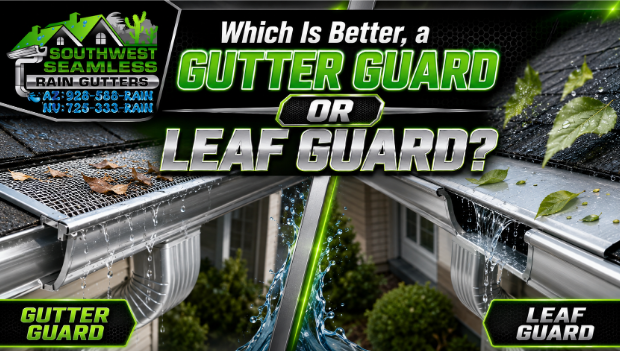
If your gutters clog every time leaves, pine needles, roof grit, or windblown debris show up, gutter protection starts looking less like an upgrade and more like a necessity. So which is better: a gutter guard or a leaf guard?
Quick answer: A gutter guard is usually the better overall term because it covers a wider range of gutter protection systems. A leaf guard is typically a type of gutter protection designed mainly to block leaves. The best choice depends on your roofline, tree coverage, gutter style, water volume, and maintenance expectations.
At Southwest Seamless Rain Gutters, we look at the entire gutter system before recommending protection. A guard that works well on one home, apartment building, or commercial property may not be the best fit for another.
What Is the Difference Between a Gutter Guard and a Leaf Guard?
Gutter guards are protective systems installed over or inside gutters to reduce clogs from leaves, debris, and roof runoff material.
Leaf guards are usually gutter covers or screens designed mainly to keep leaves out of the gutter.
In everyday conversation, people often use the terms interchangeably. The real difference is scope:
| Term | Meaning | Best Use |
|---|---|---|
| Gutter guards | Broad category for gutter protection solutions | Leaves, debris, roof grit, pine needles, general clog prevention |
| Leaf guards | Leaf-focused gutter cover systems | Homes or buildings with heavy leaf drop |
| Gutter covers | Solid or curved covers over the gutter | Larger debris and heavy leaf protection |
| Gutter screens | Mesh or perforated screening systems | Moderate debris protection |
| Gutter filter systems | Inserts or filters placed inside gutters | Smaller debris, depending on design |
Which Is Better for Preventing Clogged Gutters?
For most properties, a quality gutter guard system is better because it is designed for more than just leaves.
Leaves are a common problem, but they are not the only reason gutters clog. Many properties also deal with:
- Pine needles
- Seed pods
- Roof granules
- Dust and mud
- Small twigs
- Bird nesting debris
- Windblown trash
- Standing water from poor slope
A leaf guard may help with large leaves, but a broader gutter guard system may offer better rain gutter protection when smaller debris is part of the problem. If water is already spilling over the edge, start with why gutters overflow in heavy rain before adding any cover.
Gutter Guard Comparison: Common Types
Not every gutter protection system performs the same way. The design matters.
| System Type | Pros | Considerations |
|---|---|---|
| Mesh gutter guards | Good all-around debris protection | Fine debris can still collect on top |
| Micro-mesh guards | Better for small debris and pine needles | Usually needs professional installation |
| Perforated gutter covers | Strong and durable | Small debris may enter through openings |
| Reverse-curve covers | Moves water around a curved edge | Can overshoot during heavy rain if poorly matched |
| Foam inserts | Simple and affordable | Can trap debris and may need replacement sooner |
| Brush inserts | Easy to install | Debris can get tangled in the bristles |
For seamless gutter protection, Southwest Seamless Rain Gutters typically focuses on systems that support strong water flow, reduce clog risk, and pair well with the property’s existing or new gutter setup.
Are Gutter Guards Maintenance-Free?
No gutter protection system is completely maintenance-free.
A good system can reduce cleaning frequency, but it does not eliminate upkeep forever. Leaves may sit on top of covers, fine debris may build up over time, and downspouts still need to drain properly.
A better way to think about gutter guards: they help reduce clogging and cleaning, but they still need occasional inspection.
That honest expectation matters. Any company promising that you will never think about your gutters again is overselling it. We cover the realistic schedule in our guide to cleaning gutters that already have guards.
When Are Leaf Guards a Good Choice?
Leaf guards can be a good choice when the main problem is large leaves falling directly into open gutters.
They may work well for:
- Homes with deciduous trees nearby
- Apartment buildings with seasonal leaf buildup
- Commercial buildings with rooflines near landscaping
- Properties where gutters overflow mainly during fall
However, if your property has smaller debris, pine needles, roof grit, or heavy rainfall, a basic leaf guard may not be enough. Our breakdown of how leaf screens protect rain gutters shows where screening does and does not hold up.
When Are Gutter Guards the Better Choice?
Gutter guards are usually better when you need a more complete gutter debris protection solution.
They are a strong option if:
- Gutters clog several times a year
- Downspouts back up during storms
- Trees hang over the roof
- Cleaning gutters is unsafe or inconvenient
- You manage apartments or commercial properties
- You want to protect a new seamless gutter system
- Overflow is affecting landscaping, fascia, walkways, or foundations
For many property owners, gutter guard installation makes the most sense when paired with new seamless gutters. That allows the system to be sized, pitched, and protected correctly from the start.
Expert Tip From Southwest Seamless Rain Gutters
The best gutter protection system is not chosen by product name alone. It should match the roof, gutter size, downspout capacity, and debris type.
Before installing gutter guards or leaf guards, check:
- Gutter condition. Damaged, sagging, or undersized gutters should be corrected first.
- Water flow. Protection will not fix gutters with poor slope or too few downspouts.
- Debris type. Large leaves, pine needles, and roof granules require different solutions.
- Roof design. Steep roofs and high-volume runoff need systems that handle fast-moving water.
- Maintenance access. Apartments and commercial buildings may need lower-maintenance systems because access is more difficult.
Best Option for Homes, Apartments, and Commercial Properties
For most homes, apartments, and commercial buildings, the better choice is a professionally installed gutter guard system rather than a basic leaf guard.
A full gutter protection solution is more adaptable. It can be selected based on the building’s drainage needs, surrounding trees, roof pitch, and long-term maintenance goals.
Southwest Seamless Rain Gutters can help determine whether your property needs gutter covers, screening systems, seamless gutter protection, or a new gutter system before protection is added.
Conclusion: Choose the System, Not Just the Name
When comparing gutter guard vs leaf guard, the better option is usually a complete gutter guard system because it protects against more than leaves.
Leaf guards can help with seasonal leaf drop, but gutter guards offer broader protection for modern rain gutter systems. The right choice depends on your property, roofline, debris type, and drainage needs.
If you are tired of clogged gutters, overflow, or repeated cleaning, Southwest Seamless Rain Gutters can inspect your current system and recommend the right gutter protection solution for your home, apartment building, or commercial property.