FAQ
Ahwatukee Routing Questions
How is downspout work priced in Ahwatukee?
Routing work prices from one itemized on-site measurement — per drop, extension, re-aim, or leaderhead — $400 minimum stated up front, with the park-wash sketch on the sheet wherever your lot meets the green, so every trip's logic traces to ground you can stand on.
What materials do you use for downspout work in Ahwatukee?
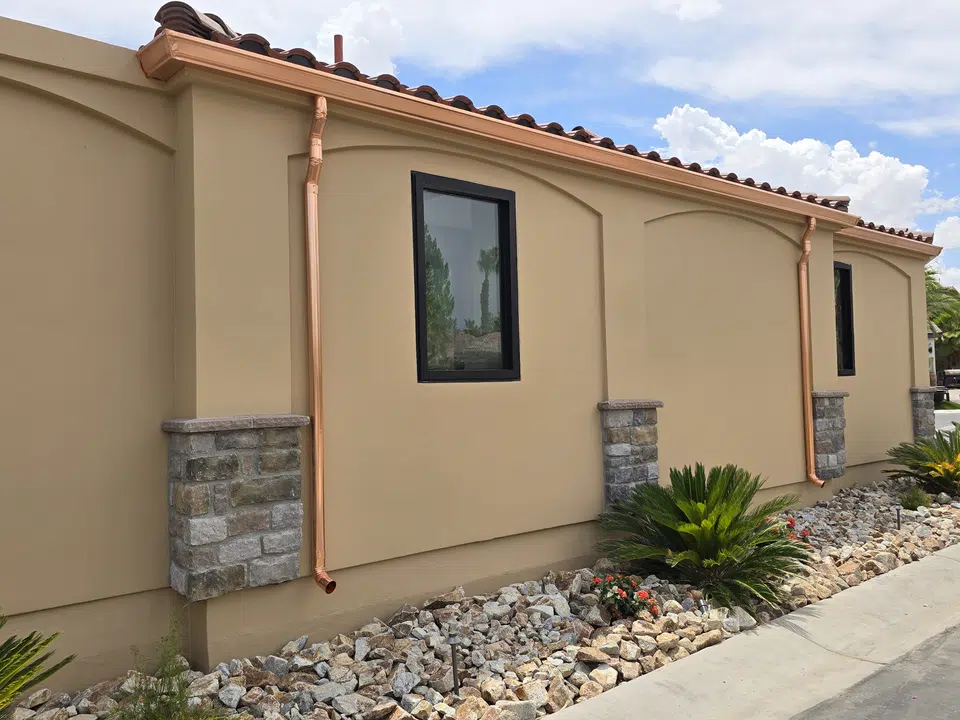
Aluminum drops and heads matched to your runs carry the village; copper serves the custom estates' drawn cases; galvanized suits the working buildings — noted honestly that its zinc coat spends down over decades and the steel beneath can eventually rust.
How fast is storm response for downspout work?
Same-week in season — greenbelt-aimed discharge and slab pooling read fast, since one trespasses on the design and the other threatens the house.
What sizes and profiles does the work cover?
Drop diameter follows the roof feeding it: we carry the standard round and rectangular profiles plus the oversized class, and the choice per location comes off each plane's computed gather — a middle-wave two-story's long rear plane often earns the big profile while its front takes standard, and the sheet shows which went where and why.
What warranty applies to this service?
The workmanship on this service is warrantied for 2 years; where genuine .032 aluminum goes up, the metal adds its own manufacturer-backed lifetime material warranty.
How long does downspout work usually take?
Routing calls usually wrap inside the visit itself: strandings extended, aims reset, edge descents fastened — and before we pull away, each corrected trip gets run at the hose so you watch your water reach the curb.
How do I know my home in Ahwatukee needs this?
If water pools at slabs, sheets a drive, lands on the greenbelt's edge, or aims over a back wall — yes. In the dual-use village, most routing complaints are one of the park's two jobs waiting to be respected.
Why does downspout work matter for monsoon season?
The season runs the whole design at once — the greenbelts carrying the mountain's share and the village's while every lot sheds its own. Finished residential trips keep your gallons in the residential lane.
Do you take on new-construction projects?
Remodels get routing from the drawings — greenbelt manners and edge descents designed on paper before the first storm tests a guess.
Do you service systems you didn't install?
Crushed drops, popped elbows, and strap failures all correct in one visit — each with the park-manners check attached at any lot the green touches.
When the big storms hit, the greenbelt behind us turns into a genuine river — should that worry us, and is there anything our gutters should be doing about it?
The river is the design working, and your gutters' job is to stay out of its story — two reassurances that fit together. When that greenbelt runs full, you're watching the park's second identity perform exactly as engineered: the channel was graded and sized to carry the mountain's south-face runoff and the village's storm loads through the pocket at design capacity, its path-lined banks built for precisely the flow that looks so dramatic from your kitchen window — drama being what competent flood infrastructure looks like when it's earning its keep. What deserves your attention is the private half: making sure your own roof isn't quietly misrouting its share — drops delivering against the foundation instead of past it, an extension that quit short of the street, discharge aimed over the back wall adding freelance gallons to a system that budgeted without you. The walk sorts that half in an hour: every trip finished to the curb on your own ground, landings placed where your lot honestly drains, the back fence crossed by nothing — so when the greenbelt runs its river, everything arriving at your slab is rain that fell on it, and the park's performance stays what it was always meant to be: something to watch, not something to join.
What licensing covers this work in Arizona?
Yes: AZROC #346705 covers this work in Arizona, we're also licensed in Nevada (NVLIC #0093742), and we carry full insurance — the paperwork is available with any estimate.
Our back yard opens onto one of the greenbelt washes — can our downspouts just point that way?
They can't, and the greenbelt's second job is the reason: that park is an engineered flood channel, its capacity sized for design storms and its banks maintained as infrastructure. Your roof's share routes to the street on your own paths — we'll walk the honest trip at the estimate, and the park keeps doing both its jobs.